
Who We Worked With
Our client is a digital lending platform in India that connects loan applicants with partner banks and NBFCs. They aren't a lender. They're an intermediary, and a network of external Business Partners (channel partners and loan agents) sources many of their leads. Their model rests on one promise: when a partner brings in a lead, that partner is credited, and paid, when the loan disburses. We're keeping their identity anonymous at their request, so we'll call them "the client" here.
The Problem: Good Voice AI Wasn't Enough
The client wanted a multilingual AI that could call new leads, qualify them and chase stalled applicants over voice and WhatsApp. Adding AI to a lending funnel isn't the hard part. The hard part is what it can break.
Every lead carries a trail from partner to campaign to customer to application, all the way to disbursement, because that trail decides who gets paid. An AI layer that dropped one link in that chain would cost partners their commission and the client their partners' trust. On top of that, the loan-processing workflow already worked, and nobody wanted to touch it.
The brief was a list of technologies, not a specification: Amazon Connect, Bedrock and AgentCore, multilingual voice, WhatsApp, outbound campaigns, RAG, security and scaling. The real question underneath was commercial: could this be built without disturbing the pipeline or the payout trail? The client wanted that answered before committing budget.
What We Built: A Front Door, Not a Rebuild
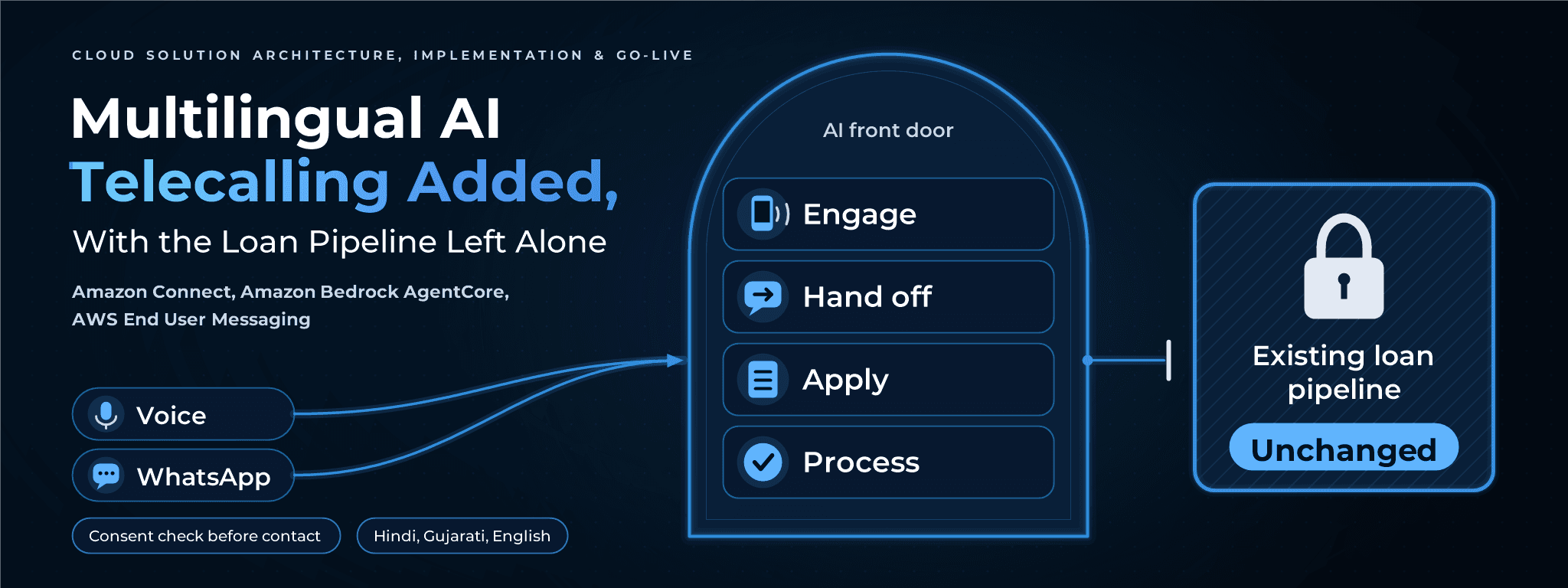
We treated the AI as a front door. It sits ahead of the client's existing application journey, which stays unchanged. We designed it, then built and launched it. The flow has four phases:
- Engage. The AI reaches a lead by voice in their preferred language, or over WhatsApp, and runs a short, structured conversation, not a long intake form. Amazon Connect handles the calls, Transcribe and Polly handle speech, and Bedrock AgentCore orchestrates each conversation.
- Hand off. Once the lead is qualified, the customer gets a secure, personalized link over WhatsApp, with SMS as a fallback, so they don't start from a blank page.
- Apply. The customer logs in to the client's existing journey: eligibility, lender selection, document upload and submission. Context from the AI conversation arrives pre-filled to confirm.
- Process. The completed case lands in the existing pipeline, with the same dashboards and the same sanctioning and disbursement flow.
Three capabilities run alongside:
- Automated follow-up. An event-driven engine spots stalls, such as an unopened link, an incomplete application or missing documents. It nudges the customer, escalates to a follow-up call, or flags a human.
- Contextual human handoff. At any stage, a person receives the customer, product, application stage, an AI summary and the pending action.
- Partner visibility. Funnel statistics feed the client's existing partner dashboard through its API, so partners see real progress, not just a call count.
Four decisions shaped the build:
- Consent before every contact. A dedicated check validates consent, purpose, channel and opt-out before any outbound call or message.
- A knowledge layer that informs but never decides. The RAG knowledge base lets the AI explain and qualify, but it has no path to approving or rejecting a loan.
- Existing systems stay in charge. The AI checks the client's system for duplicate leads and never decides lead ownership.
- Multi-tenancy at the right depth. We built tenant IDs into all data and events, with tenant-scoped access and usage tagging, so the platform can serve partners and, later, banks and NBFCs. We deliberately held back full infrastructure isolation until a real institutional tenant is onboarding, because their compliance requirements should shape what it looks like.
AWS services: Amazon Connect, Amazon API Gateway, Amazon Cognito, Amazon Transcribe, Amazon Polly, Amazon Bedrock and Bedrock AgentCore, Amazon OpenSearch Service, AWS Lambda, Amazon DynamoDB (with Streams), Amazon EventBridge, Amazon SNS, Amazon S3, AWS End User Messaging (including End User Messaging Social for WhatsApp), Amazon QuickSight, AWS KMS, AWS Secrets Manager, AWS IAM, Amazon CloudWatch (Application Signals, Lambda Insights) and AWS Backup.
What We Verified, Not Just What We Assumed
A demo that sounds good isn't the same as a system that's safe in front of real customers. We treated those as two separate questions.
The two that mattered most to the client came first. Using anonymized sample leads in the client's staging environment, we followed each lead from partner upload through to the partner dashboard and checked that the same partner, lead, customer, campaign and application IDs came through intact at every step. We then tested the AI with prompts designed to push it into approving, rejecting or quoting loan terms. It has no tool that can make that decision, and its answers point back to the client's eligibility engine and the lender. Only after both held did we call the system ready for real customers.
We also checked the ground underneath:
- Service status. Amazon Pinpoint is the service many teams would reach for to send WhatsApp and SMS, but AWS stopped onboarding new customers in 2025 and ends support on October 30, 2026. Its messaging channels now live under AWS End User Messaging, so we built on that and its WhatsApp companion directly, and confirmed both are available in Mumbai. The client never has to migrate off Pinpoint later.
- Language coverage. Transcribe and Polly support Hindi, Gujarati, Marathi, Tamil and English, but not Marwadi, which the brief had listed. We raised it before design began, and the client confirmed it wasn't a launch requirement.
- Regulation and platform policy. TRAI calling rules, RBI's digital lending directions, DPDP consent requirements and WhatsApp's template and opt-in policies went into the build as controls, including do-not-disturb screening and calling-hour limits.
Where We Left Things
A launch isn't a handover. The client left with:
- A live AI engagement layer on their existing platform, with the loan pipeline and partner payouts unchanged. It launched in Hindi, Gujarati and English, and it was built for roughly 15,000 calls a month, up to 25 at once, with about 50 partners tracking their leads in the existing dashboard.
- A consolidated architecture document and two diagrams that the client's team keeps as the reference for how the system works.
- A clear record of trade-offs. Full portability isn't possible at the AgentCore layer, so all business logic lives in code the client controls. The client reviewed and accepted this explicitly.
- Room to grow: tenant-aware data and events, ready for the bank and NBFC APIs the client plans to offer.
Why This Approach Worked
The client didn't need a bigger AI platform. They needed AI added without risking the loan pipeline or the partner payouts built on it. Treating the AI as a front door kept the journey intact. Making attribution a design constraint from day one kept partner trust intact. Stating trade-offs before development meant there were no surprises once the build began.
That's the standard we hold every engagement to: prove the thing works before calling it done, not after.
Wondering what happens to your partner attribution the day you add an AI voice agent, or just assuming it will hold? Metasips designs and builds AWS-native conversational AI for lending and fintech teams. Get in touch and let's find out before your partners do.